Today, my new book is being released! The title is “Perpetual Fire: Temple, Ritual, and Biblical Theology.”
What is Perpetual Fire about?
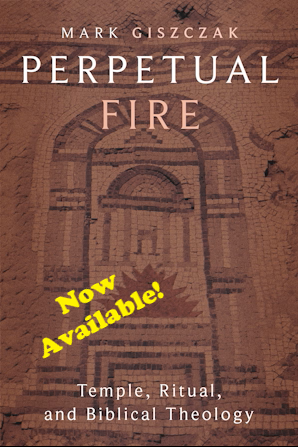 I am proposing the book as a motif study in biblical theology. It seeks to answer “What is the ritual and theological meaning of the perpetual fire on altar?” It focuses on the ever-burning fire on the altar of sacrifice at the heart of the Temple. The story of the fire is a long story–from the theophany experiences of God-as-fire in the story of Abraham and the Burning Bush scene in the life Moses to the fire that descends on Mount Sinai at the giving of the Law to the fire that comes forth from the sanctuary of the Tabernacle in Leviticus 9:24. God reveals himself as “a consuming fire” (Deut 12:29). In Leviticus 6, the priests are charged by God with keeping the fire on the altar of sacrifice perpetually burning: “it shall not go out.” But why? I take a winding tour through the early cultic legislation, prophetic metaphors for divinity as brightness, through the meaning of the Wood Offering, the significance of darkness as shrouding the brightness of divine light and the cultic meaning of radiance. As the book comes to identify the ritual significance of ever-burning fire as representing the dynamism of God, truly being a “cult image” of the Lord, it then moves onto theological considerations. If “brightness” characterizes God, then what should we make of the legends that portray Adam and Eve as “bright” or “glorious” before the Fall? How do these themes come together in the New Testament where John the Baptist promises that “one is coming who will baptize you with the Holy Spirit and with fire”? I examine the Transfiguration scene alongside the scenes of Uzziah’s failed offering of incense in the Temple and Herod Agrippa’s failed apotheosis (reported both by Acts and by Josephus). I argue that the Transfiguration scene presents Jesus as a “restored radiant Adam” that becomes the archetype for the new creation and for resurrected humanity in Christ. Eventually, the book gets into the dual nature of the fire of God–as both a source of purification for the righteous and of destruction for the unworthy, the fire is cultic and centered in the Temple sanctuary, but it also consumes the enemies of God and burns up what is worthless (wood, hay, stubble). The book works with these themes to make sense of the New Testament’s theology of fire, or at least, its fiery theological themes that have to do with both divine presence and divine judgment.
Who endorsed it and what did they say?
I am very grateful to the two scholars who offered their endorsement of the book. Check out what they have to say:
“The ritual laws that are at the heart of the Pentateuch are a puzzle for many readers of the Bible. Despite their importance, they often play little role in biblical theologies. Mark Giszczak’s stimulating study of the perpetual sacred fire challenges the marginalisation of biblical ritual that has characterised much theological reflection. Tracing the unquenchable fire across Old and New Testaments, his book will help readers see fresh and under-appreciated connections across the canon.”
— Nathan MacDonald, Professor of the Interpretation of the Old Testament and Fellow of St John’s College“In this innovative book we see biblical theology at its finest, solidly anchored in rigorous historical scholarship and providing clarifying insight into one of the most important ways God revealed himself to Israel and to the world. Mark Giszczak?s wide learning, sound judgement and balanced scholarship shine through on every page as he reveals the central importance of the sacred, ever-burning altar fire at the heart of Israelite sacrificial worship. The fire on the altar constituted a continuous theophany, effected the transfer of sacrificial gifts from the earthly to the heavenly realm, and served as an image of testing, purifying and sanctifying God?s people. Christian readers will find here the biblical background of the promised one who would baptize with the Holy Spirit and with fire and who came to cast fire upon the earth and wished it were already ablaze.”
— Stephen D. Ryan, O.P., Pontifical Faculty of the Immaculate Conception at the Dominican House of Studies
What are some other books about fire in the Bible?
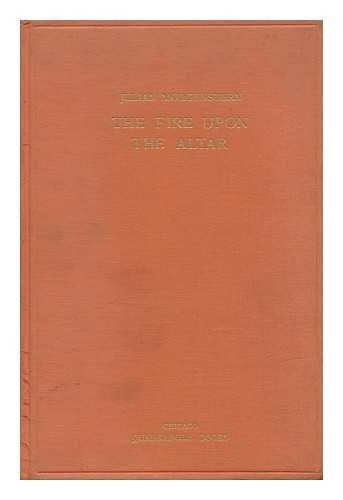 In my research, I was inspired by a handful of other books that treat fire in the Bible. One older book that is hard to find now is The Fire Upon the Altar by Julian Morgenstern (Chicago: Quadrangle Books, 1963). Morgenstern was a fascinating mid-century Jewish thinker–very creative and boundary-breaking in his own way. No, not all of his theories are convincing, but he has a way of seeing things that pulls together. From my own water-damaged copy of the book, check out his interpretation of the relighting of the altar in the time of Nehemiah as reported by 2 Maccabees: Morgenstern writes, “The legend implies further that the sacred fire was latent in the liquid, and that it needed only the application to it of a proper kindling force or essence to burst again into the sacred flame. Here this kindling force was supplied by the rays of the sun, bursting forth from the enveloping cloud and falling upon the wood upon the altar upon which the thick liquid had been poured” (p. 63). I love this episode and interpret it in detail in my book.
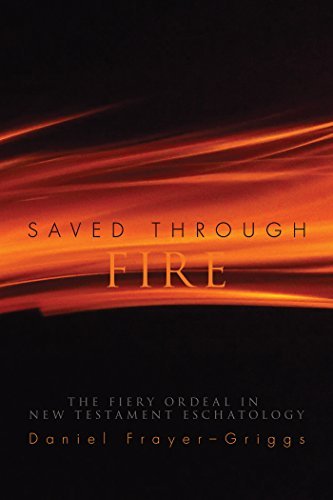 Two relatively recent books also treat the sacred fire. The first is Daniel Frayer-Griggs dissertation-turned-book: Saved Through Fire: The Fiery Ordeal in New Testament Eschatology (Pickwick, 2016). While Frayer-Griggs, a Protestant thinker, is primarily interested in how to interpret Paul’s cryptic saying that Catholic tradition regards as indicating the existence of purgatory, he ranges far and wide not only in biblical literature but in contemporaneous apocryphal literature as well. Here is a quote from his discussion of the River of Fire in apocryphal literature, “in many of the later Jewish and Christian apocalyptic visions the river of fire performs a dual function. It is an ordeal that must be endured, and those who are righteous will be saved while the wicked will be destroyed” (p. 141). By the end of the book, we find him saying some pretty compelling things that sound like exciting (and quasi-Catholic?) developments in his thought. For example, he says, “While our exegesis in no way confirms the doctrine of purgatory, it may open avenues for discussion of the origins of this doctrine and facilitate a Protestant reevaluation of the purificatory function of fire in New Testament eschatology” (p. 246).
 The other recent book that examines the divine fire is “Your God is a Devouring Fire”: Fire as a Motif of Divine Presence and Agency in the Hebrew Bible (CBQMS 57; 2019) by Michael R. Simone, SJ. This book is deep and detailed study of the Hebrew passages that discuss the fire on the altar. Simone himself regards his main inspirations as Benjamin Sommer’s famous book Bodies of God and the World of Ancient Israel (Cambridge, 2008) and Shawn Zelig Aster, Unbeatable Light (Ugarit-Verlag, 2012). He works through passages, translating from the Hebrew, interpreting carefully and drawing from contemporary scholarly discourse. One of his main conclusions is that “Cultic fire did not represent a divine body, but it did represent divine agency sent out from Yhwh to accomplish his divine will. The primary purpose of cultic fire was the transmission of offerings to the divine realm” (p. 96). I interact with Simone’s work in my book, but Frayer-Griggs gets mentioned a bit more. Both of these books are important contributions to this scholarly discussion.
Where can I buy a copy of the book?
You can find my new book, Perpetual Fire: Temple, Ritual, and Biblical Theology at the Baylor University Press website: https://www.baylorpress.com/9781481323222/perpetual-fire/
It is also available at
- Amazon: https://a.co/d/0fAP2Lua
- Barnes & Noble: https://www.barnesandnoble.com/w/perpetual-fire-mark-giszczak/1150303521?ean=9781481323222
Of course, I hope that you read my new book and I hope you enjoy what you read, learn something new about the ancient Temple, the worship of the Lord, and the power of fire as a sacramental symbol for divinity.